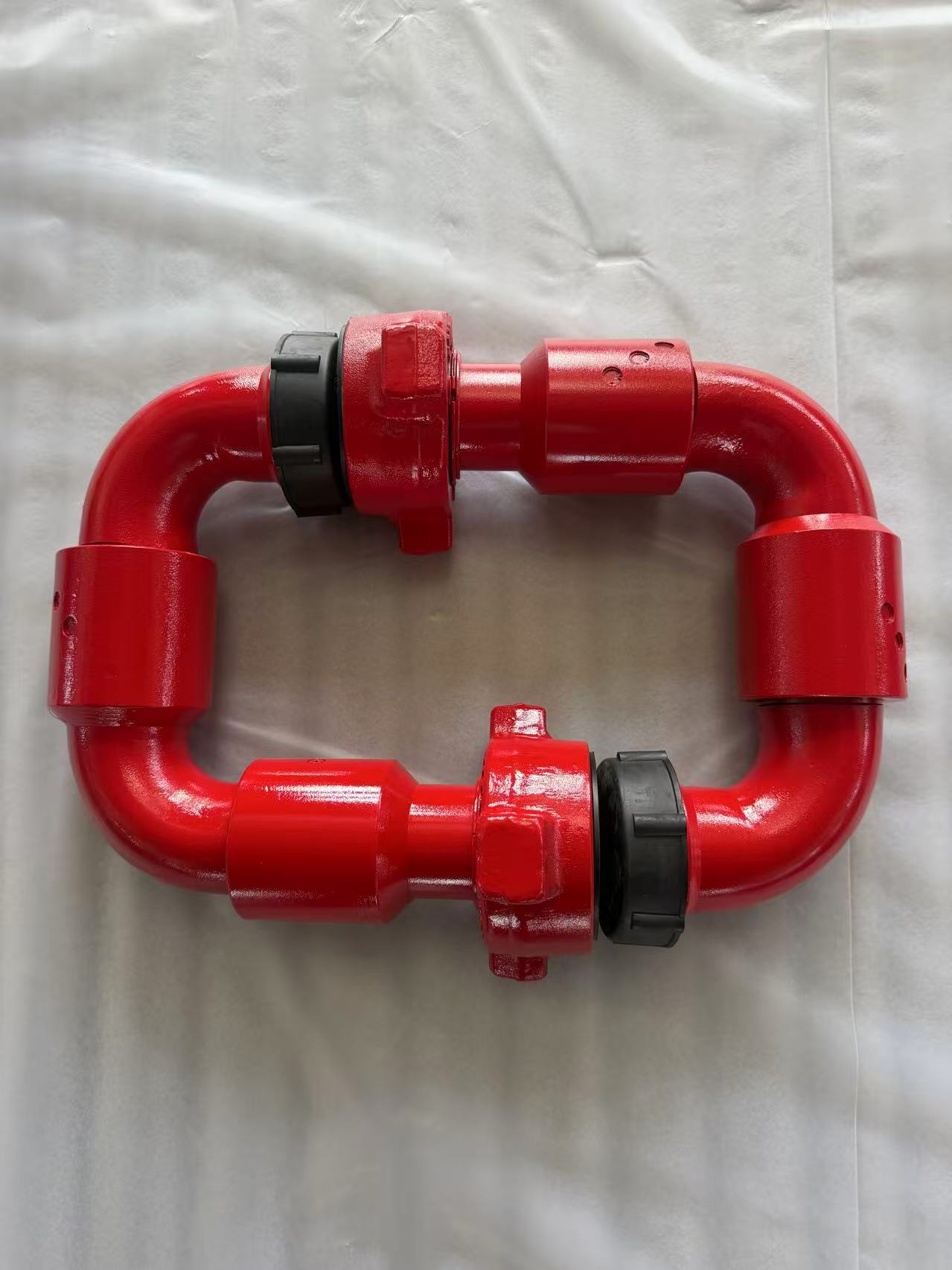
Swivel joint packing is the seal that lets a joint rotate while still holding pressure, and it wears out gradually rather than all at once. Weep at the packing area, stiff or uneven rotation, and visible damage around the seal are the early signs that packing is reaching the end of its useful life. Catching those signs during inspection, and planning the replacement before the joint is needed on a job, is far cheaper and safer than discovering a failed seal after a line is made up.
What packing does in a swivel joint
A swivel joint exists so a treating line can change direction without breaking the line apart. One part of the joint stays fixed while the other rotates, which lets crews lay out a line around equipment, adjust an angle during rig-up, and absorb some movement once the line is in place. That rotation is only useful if the joint still seals while it turns, and that is the packing's job.
Packing sits in the joint where the rotating parts meet, closing the small gap between them so fluid stays inside the bore even as the joint moves. It is a wearing part by design: every rotation, every pressure cycle, and every exposure to the fluid in the line works on it a little. A joint that is inspected regularly will usually show packing wear long before it becomes a failure, which is why packing deserves its own check rather than being lumped in with a general look at the joint.
Signs of wear to watch for
- Weep or dampness at the packing area: a faint wet line, a drip, or a stain around the seal that returns after wiping is often the first sign. A dry packing area is what a healthy joint looks like; a joint that stays damp is telling you something.
- Stiff, gritty, or uneven rotation: a joint that turns smoothly through its range when new, then starts to bind, catch, or feel rough at one point in the turn, may have packing that is worn unevenly or contaminated with grit.
- A joint that will not hold its position: if a swivel drifts, sags, or will not stay where it is set, the internal fit may have loosened as the packing wore, and the joint should be assessed rather than propped into place.
- Visible damage around the seal: nicks, scoring, or a packing area packed with dried mud, sand, or debris suggests the seal has been working in dirty conditions and may not be sealing evenly.
- A joint that has been idle for a long time: packing can take a set during months of storage, so a joint pulled from storage deserves a rotation check and a close look at the packing area before it goes back into a line.
- A history of hard service since the last check: joints that have seen many jobs, many pressure cycles, or long runs since their last inspection are more likely to be near the end of a packing's life, even if they still look tidy from the outside.
What else can look like a packing problem
Not every weep near a swivel joint is a packing problem, and treating it as one can waste a good packing kit. A union next to the joint may be the real source: a union that is not fully made up, a thread damaged by mud or repeated make-up, or a sealing face with a nick will all show up as dampness in the same area. Before ordering parts, trace the wetness to its source by cleaning the joint and the unions on both sides, then watching where the dampness returns.
Rotation trouble has lookalikes too. A joint can feel stiff because it is bent by a line that is pulling on it, because a support has shifted, or because debris is packed around the outside of the joint rather than inside it. Checking the layout, the supports, and the outside of the joint first costs little and can save an unnecessary teardown. When the source is still unclear after those checks, treat the joint as unverified, keep it out of a pressurized line, and ask the supplier to confirm the configuration by style and drawing number.
Replacement basics: what a packing job usually involves
A packing replacement starts before any tool is picked up. The joint must be isolated and depressurized under the site procedure, and the work must be done by people qualified for it, with the line confirmed safe to open. Packing is never changed on a live or pressurized joint, and a joint that is still connected to a line that could see pressure is not ready for this work. Once the joint is safely out of service, the old packing is removed, the sealing surfaces and the bore area are cleaned and inspected for scoring or damage, and the new packing is fitted to match the joint's style, size, and configuration.
That last point matters more than it sounds. Packing is not a one-size part: it must match the specific joint it goes into, and the reliable way to confirm the match is the joint's style and drawing or part number, not a guess from its appearance. A Style 10 joint and a Style 50 joint may look similar at a glance, but their packing should never be assumed interchangeable. Keep the joint's identification with the job, fit the packing made for that joint, and check rotation and sealing again after reassembly under the site procedure before the joint returns to service. If a sealing surface is scored or damaged, a new packing alone may not restore the seal, and the joint should be assessed for repair or replacement as a whole rather than sent back out on hope.
Planning ahead makes all of this easier. Keep a spare swivel joint, or at least a spare packing set for each style in service, staged where the crew can reach it, and keep a simple record of which joints have had packing replaced and when. That record turns packing from a surprise into a scheduled item: joints that have not been touched in a long time move to the front of the inspection list, and a crew heading to a job knows which spares to load before they leave the yard.
Where Sterling can help
Sterling Wellhead stocks new 2-inch FIG 1502, 10,000 PSI flow iron in Jourdanton, Texas 78026, including Style 10 and Style 50 swivel joints (T000620, T000693), the T000856 plug valve, and 4 ft, 6 ft, and 10 ft pup joints (T000864, T000866, T000855). If you are checking a swivel joint for packing wear, or confirming that a spare joint matches an existing line, send the style, size, union figure, and drawing numbers and our team will confirm the configuration by drawing number. Sterling is RFQ-only: contact sales@sterlingwellhead.com or +1 (512) 373-0384.
Frequently asked questions
Can I keep running a swivel joint that weeps slightly?+
A slight weep is a warning, not a condition to work around. Flag the joint, keep it under inspection, and plan the packing replacement or joint assessment before the next job. A weep that grows under pressure can become a leak, and a joint already showing wear should not be trusted to improve on its own.
Is packing for a Style 10 joint the same as packing for a Style 50 joint?+
Do not assume so. Confirm the packing by the joint's style, size, and drawing or part number, and ask the supplier to match it if you are unsure. Fitting packing made for a different joint is a mismatch, even if it looks close.
How often should swivel packing be replaced?+
There is no single calendar answer: it depends on how often the joint rotates, how many pressure cycles it sees, and what inspection finds. Replace packing when inspection shows weep, stiff or uneven rotation, or visible wear, and follow the site procedure for inspection intervals. A simple record of past replacements helps spot joints that are due for a closer look.